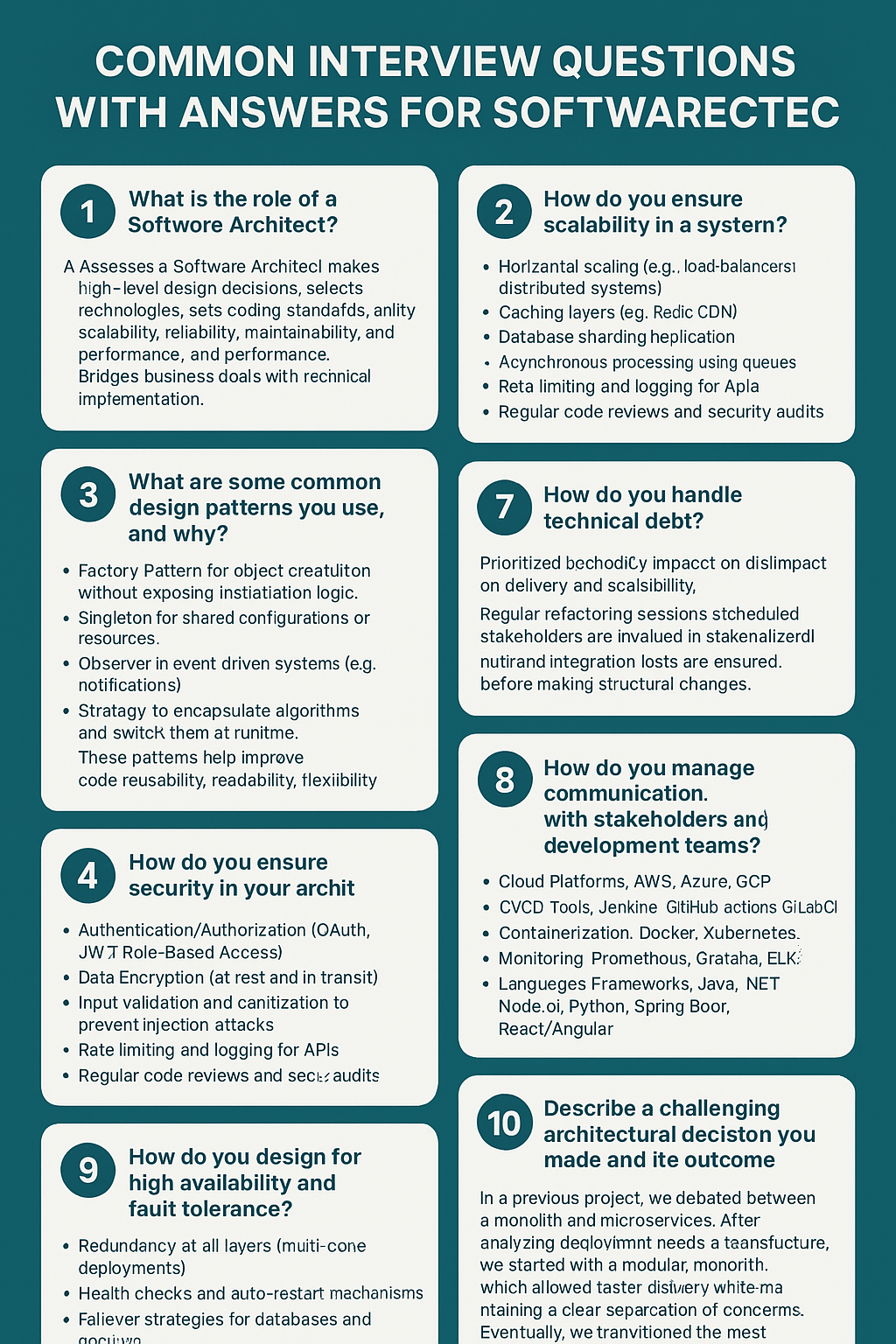
✅ 1. What is the role of a Software Architect?
Answer: A Software Architect is responsible for making high-level design decisions, selecting appropriate technologies, setting coding standards, and ensuring system scalability, reliability, maintainability, and performance. They bridge the gap between business goals and technical implementation, often mentoring developers and coordinating with stakeholders.
✅ 2. How do you choose between different architectural styles (e.g., monolithic, microservices, serverless)?
Answer: I assess based on system requirements like scalability, maintainability, team structure, deployment frequency, and performance needs.
- For simple applications, a monolith can be efficient.
- Microservices work best for large teams or when services need independent scalability.
- Serverless is ideal for event-driven architectures with variable workloads and cost optimization needs.
✅ 3. What are some common design patterns you use, and why?
Answer:
- Factory Pattern for object creation without exposing instantiation logic.
- Singleton for shared configurations or resources.
- Observer in event-driven systems (e.g., notifications).
- Strategy to encapsulate algorithms and switch them at runtime.
These patterns help improve code reusability, readability, and flexibility.
✅ 4. How do you ensure scalability in a system?
Answer: I consider:
- Horizontal scaling (e.g., load balancers, distributed systems).
- Caching layers (e.g., Redis, CDN).
- Database sharding/replication.
- Asynchronous processing using queues.
- Design systems to be stateless where possible to ease scaling.
✅ 5. How do you ensure security in your architecture?
Answer: Security is a core concern:
- Authentication/Authorization (OAuth, JWT, Role-Based Access).
- Data Encryption (at rest and in transit).
- Input validation and sanitization to prevent injection attacks.
- Rate limiting and logging for APIs.
- Regular code reviews and security audits.
✅ 6. How do you handle technical debt?
Answer: I prioritize tech debt based on its impact on delivery and scalability. I schedule regular refactoring sessions, involve stakeholders in cost-benefit analysis, and ensure unit and integration tests are in place before making structural changes.
✅ 7. How do you manage communication with stakeholders and development teams?
Answer: I use clear documentation, architecture diagrams (e.g., C4 model), and hold regular sync-ups. I translate technical complexity into business terms and ensure developers understand the “why” behind decisions through mentoring and collaborative design sessions.
✅ 8. What tools or technologies do you usually work with?
Answer: It depends on the stack, but commonly:
- Cloud Platforms: AWS, Azure, GCP
- CI/CD Tools: Jenkins, GitHub Actions, GitLab CI
- Containerization: Docker, Kubernetes
- Monitoring: Prometheus, Grafana, ELK stack
- Languages/Frameworks: Java, .NET, Node.js, Python, Spring Boot, React/Angular
✅ 9. How do you design for high availability and fault tolerance?
Answer:
- Redundancy at all layers (multi-zone deployments).
- Health checks and auto-restart mechanisms.
- Failover strategies for databases and services.
- Use of circuit breakers (e.g., Netflix Hystrix).
- Design using CAP Theorem trade-offs as per use case.
✅ 10. Describe a challenging architectural decision you made and its outcome.
Answer: [This should be personalized. Example:]
“In a previous project, we debated between a monolith and microservices. After analyzing deployment needs and team structure, we started with a modular monolith, which allowed faster delivery while maintaining a clear separation of concerns. Eventually, we transitioned the most critical modules into microservices with minimal rework.”
Thanks for your comments.
Very good
Cool